A very cool blog from the New York Times explaining recent theories proposed as to why humans are the only hairless primate.
The new idea? To get rid of fleas!
I HATE fleas, so I say good riddance!
Tuesday, April 28, 2009

Wednesday, April 22, 2009
C'mon, get happy!
Why? For one thing, your smile predicts how happy you'll be in marriage. However, love at first sight might be genetic, so don't take it too hard if you don't feel immediate sparks.
If you need help getting happy and connecting with others, try playing. Why? Because play is the glue that keeps societies together, according to Peter Gray.
You know what also works? Tickling and scritching.
If you need help getting happy and connecting with others, try playing. Why? Because play is the glue that keeps societies together, according to Peter Gray.
"Hunter-gatherers used humor, deliberately, to maintain equality and stop quarrels, Gray contends, and their means of sharing had game-like qualities. Their religious beliefs and ceremonies were playful, founded on assumptions of equality, humor, and capriciousness among the deities. They maintained playful attitudes in their hunting, gathering, and other sustenance activities, partly by allowing each person to choose when, how, and how much they would engage in such activities."Just remember, play is important to your social well-being.
You know what also works? Tickling and scritching.
Thursday, April 16, 2009
How does photography change culture?
Photography is a love of mine, and how people use photography and how it effects them is also an interest. A couple of blogs are talking about the Smithsonian Institute's new exhibit "Click! Photography Changes Everything."
I grabbed the post from blog Material World. Check it out.
From the post:
The exhibit is also inviting viewers to participate by choosing photographs that affected them and explain why. This is a cool social experiment in itself; what types of photographs do people deem noteworthy and why? How do these pieces of paper or collection of pixels shape how we see the world? Why is seeing an image so much more powerful for most people than verbal explanations of it?
I grabbed the post from blog Material World. Check it out.
From the post:
"The Initiative is collecting and sharing images and narratives that shed light on how photography influences who people are, what people do and what people remember. Has a photograph been used to document property loss, inspire a hairstylist, sell a house, beat a traffic ticket or helped with the decision about where to go on vacation? Has a single photograph ever influenced what someone believes in or who someone loves?"
The exhibit is also inviting viewers to participate by choosing photographs that affected them and explain why. This is a cool social experiment in itself; what types of photographs do people deem noteworthy and why? How do these pieces of paper or collection of pixels shape how we see the world? Why is seeing an image so much more powerful for most people than verbal explanations of it?
Tuesday, April 7, 2009
Latest news on female primates, of the human and non-human variety
The latest and the greatest about women primates!
1. hot climates tend to produce more girls
2. Márta Daróczi-Szabó, an archaeozoologist at Eötvös Loránd University in Budapest, recently lead an archaeological dig that found up to 10 dogs sacrificed and buried near house foundations, apparently as a way to ward off evil. Dogs protecting the home, in a somewhat odd way.
3. And finally, the slightly annoying practice of my mother-in-law constantly stealing food from her son's plate actually had an evolutionary reasoning behind it: by stealing food, female orangutans test the patience and hospitality of males to see if they'd be good mates. So all those years of stealing actually trained my husband to be a good mate. Thanks Judy!
Saturday, March 28, 2009
It's in his kiss!
Betty Everett was right!
Recent studies have found that saliva contains chemical and hints of evolutionary fitness, so when you're swapping spit with your significant other, you're literally giving them cues and chemicals that describe to them if you'd be a good fit.
It also promotes pair bonding, decreases cortisol, and burns calories. What's not to like?
Brought to us by Helen Fisher, Rutgers University, at the annual conference of the American Association for the Advancement of Science (AAAS) in Chicago. She is the official "love" anthropologist who studies human bonding, and who they pull out every Valentine's Day to explain why we love each other. But overall pretty sweet gig.
Recent studies have found that saliva contains chemical and hints of evolutionary fitness, so when you're swapping spit with your significant other, you're literally giving them cues and chemicals that describe to them if you'd be a good fit.
It also promotes pair bonding, decreases cortisol, and burns calories. What's not to like?
Brought to us by Helen Fisher, Rutgers University, at the annual conference of the American Association for the Advancement of Science (AAAS) in Chicago. She is the official "love" anthropologist who studies human bonding, and who they pull out every Valentine's Day to explain why we love each other. But overall pretty sweet gig.
Friday, March 27, 2009
Why kids LOVE sugar
I just thought this was interesting; kids crave sugar the most, or love the sweetest juices, when they're growing the fastest. Cravings for super sweet things tends to die down around 16, around the age that most of us significantly slow or even stop growing.
Very cool study that I would have loved to have been in as a kid. Actually, according to my mother I didn't like very many sweets, AND I am only 5'2". Coincidence? Hmm...
Very cool study that I would have loved to have been in as a kid. Actually, according to my mother I didn't like very many sweets, AND I am only 5'2". Coincidence? Hmm...
Thursday, March 26, 2009
Dog societies closest to humans'
According to this researcher in Hungary, dog social behavior most mirrors humans, more than chimps, gorillas, meerkats, whatever.
He believes that we should study dog culture to better understand humans. I am all for it, and completely agree with his findings. However, I think he and other dog researchers need to make it super-clear why dogs are so similar...because we essentially bred them to be.
First, yes, dogs adapted to us (nonconclusively, but their bones have been found near human archaeological sites as old as 40,000 years or more). But now, for the domestic dog their social structure is dependent on us, in a way.
I think studing the wild relatives - coyotes, wolves, wild dogs - provides a more independent understanding of social predator lifestyles outside of humans, if that's what you're going for. If you're looking for "a mirror into humanity," but in a somewhat look-what-we-can-do sort of way, then sure.
Jozsel Topal, lead author of the study, says that by studying humans, dogs, and wolves together we can triangulate findings about social predator behaviors. The article also quotes Marc Hauser as saying that dogs' evolution being manipulated by humans over the years is a good thing to study and provides insight into how we evolved. But we have to remember that dogs became dogs because their ancestors ALREADY were social creatures who had society structures.
To me it feels like unless you're studying packs of feral dogs, it's like studying a goldfish in a tank and trying to figure out how a koi fish acts in a large pond. You have to acknowledge the co-dependence.
I think studying dog behavior is important. In fact I would LOVE to study dog behavior for a living. But my hang up is saying that dog societies are the most like humans' societies, without stipulating that we MADE them that way, is careless at best.
He believes that we should study dog culture to better understand humans. I am all for it, and completely agree with his findings. However, I think he and other dog researchers need to make it super-clear why dogs are so similar...because we essentially bred them to be.
First, yes, dogs adapted to us (nonconclusively, but their bones have been found near human archaeological sites as old as 40,000 years or more). But now, for the domestic dog their social structure is dependent on us, in a way.
I think studing the wild relatives - coyotes, wolves, wild dogs - provides a more independent understanding of social predator lifestyles outside of humans, if that's what you're going for. If you're looking for "a mirror into humanity," but in a somewhat look-what-we-can-do sort of way, then sure.
Jozsel Topal, lead author of the study, says that by studying humans, dogs, and wolves together we can triangulate findings about social predator behaviors. The article also quotes Marc Hauser as saying that dogs' evolution being manipulated by humans over the years is a good thing to study and provides insight into how we evolved. But we have to remember that dogs became dogs because their ancestors ALREADY were social creatures who had society structures.
To me it feels like unless you're studying packs of feral dogs, it's like studying a goldfish in a tank and trying to figure out how a koi fish acts in a large pond. You have to acknowledge the co-dependence.
I think studying dog behavior is important. In fact I would LOVE to study dog behavior for a living. But my hang up is saying that dog societies are the most like humans' societies, without stipulating that we MADE them that way, is careless at best.
Wednesday, March 25, 2009
Chimps dig (for) honey
Awesome footage of chimpanzees using massive sticks and logs to knock down bee hives to get to the honey. I love the one guy who hammers the bee hive holding onto the branch with both his hand and foot.
A day in the life of a Hunter forager
Anthropology buffs should check out this post on our other blog about activity patterns of hunter foragers:
http://naturalathletics.blogspot.com/2009/03/day-in-life-of-hunter-forager.html
http://naturalathletics.blogspot.com/2009/03/day-in-life-of-hunter-forager.html
Sunday, March 15, 2009
Evolution of the mind
This is an older (from February) interview from Discover Magazine with Nobel laureate and neuroscientist Gerald Edelman. Edelman is interested in studying what makes each human mind so unique, and thinks he may have found the answer: natural selection of the brain!
"Neurons proliferate and form connections in infancy; then experience weeds out the useless from the useful, molding the adult brain in sync with its environment." His latest book, which I have no read, is called Second Nature: Brain Science and Human Knowledge.
I think this is an interesting theory, but need to read more about it before I feel comfortable forming any opinions on it. After reading the interview, let me know what you think.
"Neurons proliferate and form connections in infancy; then experience weeds out the useless from the useful, molding the adult brain in sync with its environment." His latest book, which I have no read, is called Second Nature: Brain Science and Human Knowledge.
I think this is an interesting theory, but need to read more about it before I feel comfortable forming any opinions on it. After reading the interview, let me know what you think.
Thursday, March 5, 2009
Robot love
A baby monkey in the U.K. gets a stuffed surrogate mom with a mechanical heart while her mom recovers from a c-section, so the little DeBrazza baby can lie against the toy and be comforted by her "mom's" heartbeat. Awwww.....
Teams in Italy and the U.K. are currently developing a robot kid. This robot has been programmed to learn how to crawl, walk, an move, using the leading theories today of child development. The best part, the schematics on how to make the kid are open access, meaning ANYONE who has serious robotics training could potentially make and teach this robot kid. They hope this will speed the development of the robot, including developing nerves and sensing skin for the kiddo. My favorite part in the film clip (see link), is when the robot gets "falls asleep."
Teams in Italy and the U.K. are currently developing a robot kid. This robot has been programmed to learn how to crawl, walk, an move, using the leading theories today of child development. The best part, the schematics on how to make the kid are open access, meaning ANYONE who has serious robotics training could potentially make and teach this robot kid. They hope this will speed the development of the robot, including developing nerves and sensing skin for the kiddo. My favorite part in the film clip (see link), is when the robot gets "falls asleep."
Wednesday, March 4, 2009
Better tools
A troop of chimps has learned how to build a better termite trap.
Going back in time, 13,000 year old, blood-stained tools were found in a guy's back yard in Colorado.
Going back in time, 13,000 year old, blood-stained tools were found in a guy's back yard in Colorado.
Kindness for the win!
A new study found it's not survival of the fittest that promotes humans to the next generation, but survival of the kindest.
Woot! Kind people rule!
Woot! Kind people rule!
Sunday, March 1, 2009
Playing with the gorillas
Rafe and I once again ventured to the zoo. Our primate highlight this trip: the baby gorilla! The last time we were there the little girl was more interested in snuggling with her mom and sister, but this time she was ready to play!(and eat bark, but to each her own).
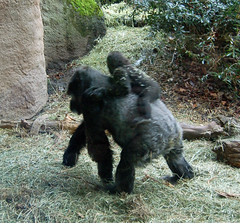
It was fascinating to see the baby and her older sister playing together. The sister would pound her chest as the play signal to start chasing her, and the baby would start chasing the sister in circles around their mom. The baby tried it a couple of times, but couldn't quite get it down, so she looked like she was trying the rub-belly/pat-head trick that kids try. The two would also play wrestle a little, and then start chasing again. Usually the baby chased the sister, I think the sister chased the baby once.
The sister also carried the baby under her belly and on her back, letting the baby jump off.
The mom was pretty patient with the whole thing, only reaching in a couple of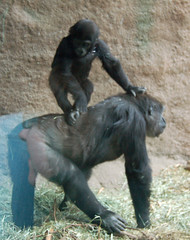 times and pulling the baby out of the play fighting to calm her down, or to breastfeed her. The way that kid went for the nipple man, WOW, poor mom.
Since I am studying play right now for my thesis, watching these two spend time playing was just fascinating and made my week!
I felt so honored to see this family hanging out, getting along, and playing.
See more photos on my flickr.
It was fascinating to see the baby and her older sister playing together. The sister would pound her chest as the play signal to start chasing her, and the baby would start chasing the sister in circles around their mom. The baby tried it a couple of times, but couldn't quite get it down, so she looked like she was trying the rub-belly/pat-head trick that kids try. The two would also play wrestle a little, and then start chasing again. Usually the baby chased the sister, I think the sister chased the baby once.
The sister also carried the baby under her belly and on her back, letting the baby jump off.
The mom was pretty patient with the whole thing, only reaching in a couple of
times and pulling the baby out of the play fighting to calm her down, or to breastfeed her. The way that kid went for the nipple man, WOW, poor mom.Since I am studying play right now for my thesis, watching these two spend time playing was just fascinating and made my week!
I felt so honored to see this family hanging out, getting along, and playing.
See more photos on my flickr.
Wednesday, February 18, 2009
Zoo photos
This has truly become the zoo blog rather than much complex interplay. It's pretty much just me and the other invisible contributor - aka my husband Rafe - sharing our adventures at the Woodland Park Zoo in Seattle, WA. But there is a lot to explore there, and we are happy to support research and preservation of habitats for all animals.
For example, Rafe's birthday adventure? What else - taking our family and friends to the zoo to see their primate brethren.
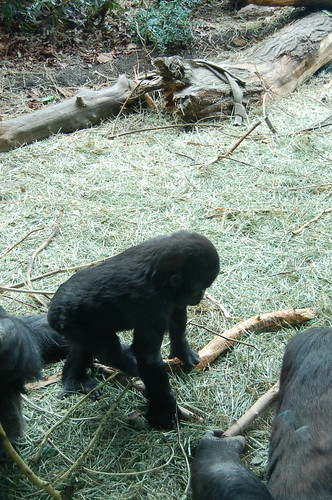
Baby gorilla wants to play with or eat the stick, I can't tell.
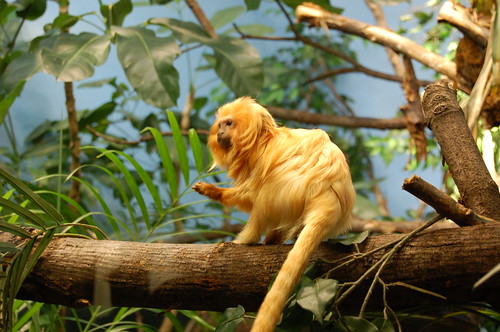
Golden lion tamarin (aka marmoset) doin' her thing.
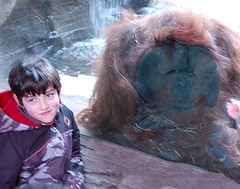
My nephew Gage is not impressed with the orangutan (and the orangutan doesn't look all that impressed either).
I am always fascinated to see these guys in action. They all have their own movement and behavioral patterns, yet these patterns are also so recognizable as being shared by us humans.
See all the photos from that day on my Flickr.
For example, Rafe's birthday adventure? What else - taking our family and friends to the zoo to see their primate brethren.
Baby gorilla wants to play with or eat the stick, I can't tell.
Golden lion tamarin (aka marmoset) doin' her thing.
My nephew Gage is not impressed with the orangutan (and the orangutan doesn't look all that impressed either).
I am always fascinated to see these guys in action. They all have their own movement and behavioral patterns, yet these patterns are also so recognizable as being shared by us humans.
See all the photos from that day on my Flickr.
Subscribe to:
Posts (Atom)

 Posts
Posts

