Jonah Lehrer, mastermind behind Front Cortex, has "always been fascinated by tip-of-the-tongue moments. It's estimated that, on average, people have a tip-of-the-tongue moment at least once a week. Perhaps it occurs when you run into an old acquaintance whose name you can't remember, although you know that it begins with the letter "J." Or perhaps you struggle to recall the title of a recent movie, even though you can describe the plot in perfect detail.
What's interesting about this mental hiccup is that, even though the mind can't remember the information, it's convinced that it knows it, which is why we devote so many mental resources to trying to recover the missing word. (This is a universal experience: The vast majority of languages, from Afrikaans to Hindi to Arabic, even rely on tongue metaphors to describe the tip-of-the-tongue moment.) But here's the mystery: If we've forgotten a person's name, then why are we so convinced that we remember it? What does it mean to know something without being able to access it?
The larger question is how the mind decides what to think about. After all, if we really don't know the name - it's nowhere inside our head - then it's a waste of time trying to find it. This is where metacognition, or thinking about thinking, comes in handy. At any given moment, we automatically monitor the flux of thoughts, emotions and errata flowing in the stream of consciousness. As a result, when a name goes missing we immediately analyze the likelihood of being able to remember it. Do we know the first letter of the name? Can we remember other facts about the person? Are we able to remember the first names of other acquaintances from high school? Based on the answer to these questions, we can then make an informed guess about whether or not it's worth trying to retrieve the misplaced memory.
Interestingly, a new experiment with a variety of primates (gorillas, chimpanzees, bonobos and orangutans) demonstrated that great apes also demonstrate some rudimentary metacognitive skills. The study, conducted by Josep Call at the Max Planck Institute for Evolutionary Anthropology, involved presenting the primates with two hollow tubes. One of the tubes came with a food reward, while the other was empty. The apes were then observed as they searched for the reward.
Read on for the results.
Showing posts with label primate. Show all posts
Showing posts with label primate. Show all posts
Thursday, April 1, 2010

Wednesday, March 31, 2010
Just how connected we primates are
I feel bad just dumping links onto the page, but if I don't do it this way it just isn't going to happen:
Radiolab's tragic story about Lucy, who was raised by humans.
Wednesday, February 3, 2010
Altruism in primates
Bonobos find it easier to share than chimps do, although young chimps do just as well as bonobos of all ages. It was speculated to be because bonobos don't have to worry about having more or less food like chimps do.
At the same time, chimps will adopt orphaned kiddos, according to a new study that found 18 cases of orphaned chimps being adopted in the wild.
Speaking of more and less, researchers based at the Institute of Neurobiology at the University of Tubingen in Germany set out to see whether rhesus monkeys could learn and flexibly apply the greater-than and less-than rule. They tested the monkeys with groups of both ordered and random dots, many of which were novel combinations to ensure that the subjects couldn't have simply memorized them. The monkeys were cued into applying either the greater-than or less-than rule by the amount of time that elapsed between being shown the first and second group of dots.
"The monkeys immediately generalized the greater than and less than rules to numerositiesthat had not been presented previously," the two researchers, Sylvia Bongard and Andreas Nieder, wrote. "This indicates that they understood this basic mathematical principle irrespective of the absolute numerical value of the sample displays." In other words: "They had learned an abstract mathematical principle."
Tuesday, December 29, 2009
Wide spread tool use in primates
Despite the common perception, tool use is not just a sporadic behavior among animals; it's especially prevalent in primates.

For example, chimps use cleavers and anvils as tools to chop food. Chimps in the Nimba Mountains of Guinea, Africa, use both stone and wooden cleavers, as well as stone anvils, to process Treculia fruits.
The apes are not simply cracking into the Treculia to get to otherwise unobtainable food, say researchers.
Instead, they are actively chopping up the food into more manageable portions.
PhD student Kathelijne Koops and Professor William McGrew of the Leverhulme Centre for Human Evolutionary Studies, University of Cambridge, UK, studied a group of chimps living wild in the Nimba Mountains.
The apes' use of such tools can be surprisingly sophisticated. "For example, nut-cracking in the Bossou chimpanzee community in Guinea involves the use of a movable hammer and anvil, and sometimes the additional use of stabilising wedges to make the anvil more level and so more efficient," explains Ms Koops. "Termite fishing in some chimpanzee communities in the Republic of Congo involves the use of a tool set, i.e. different tool components used sequentially to achieve the same goal.
"These chimpanzees were found to deliberately modify termite fishing probes by creating a brush-end, before using them to fish for termites."

How do these animals keep their teeth healthy? Floss after a meal. At least one does. A macaque in Japan flosses its teeth with its hair, demonstrating that humans aren't the only animals that clean their teeth and invent tools to help with the task.

The apes are not simply cracking into the Treculia to get to otherwise unobtainable food, say researchers.
Instead, they are actively chopping up the food into more manageable portions.
PhD student Kathelijne Koops and Professor William McGrew of the Leverhulme Centre for Human Evolutionary Studies, University of Cambridge, UK, studied a group of chimps living wild in the Nimba Mountains.
The apes' use of such tools can be surprisingly sophisticated. "For example, nut-cracking in the Bossou chimpanzee community in Guinea involves the use of a movable hammer and anvil, and sometimes the additional use of stabilising wedges to make the anvil more level and so more efficient," explains Ms Koops. "Termite fishing in some chimpanzee communities in the Republic of Congo involves the use of a tool set, i.e. different tool components used sequentially to achieve the same goal.
"These chimpanzees were found to deliberately modify termite fishing probes by creating a brush-end, before using them to fish for termites."

The flosser, a free-ranging, middle-aged, female Japanese macaque named Chonpe, may have come up with the tool and the idea, according to a new study that will appear in the January issue of Primates.
Lead author Jean-Baptiste Leca told Discovery News that dental flossing could have been a fortuitous yet "accidental byproduct of grooming."
Leca, a post-doctoral fellow at Kyoto University's Primate Research Institute, explained that "Japanese macaques sometimes bite into hair or pull it through their mouths to remove external parasites."
The hair might have become stuck in Chonpe's teeth, and as she drew the hairs out, "she may have noticed the presence of food remains attached to them."
"The immediate reward of licking the food remains off the hair may have encouraged her to repeat the behavior for the same effect in the future," he added.
Thursday, October 8, 2009
Rhesus Moms coo over their babies (awwww)
We all knew that all primate moms are generally awesome, but now a new study has found that Rhesus Macaque moms do the same sort of bonding stuff with their babies that human moms do; stare at their faces, cuddle, make faces at them...you know, the stuff that moms and babies think are really fun but grosses everyone else out. *joke*
Everybody say it with me now...awwww....

Researchers saw mothers actively searching for the infant's gaze, sometimes holding the infant's head and gently pulling it towards her face, as this mother macaque does.
Everybody say it with me now...awwww....

Researchers saw mothers actively searching for the infant's gaze, sometimes holding the infant's head and gently pulling it towards her face, as this mother macaque does.
Tuesday, August 18, 2009
Monkey see, monkey do, monkey approve
From MSNBC:
We humans often imitate the body postures or mannerisms of people we meet, usually without either person realizing it.
We humans often imitate the body postures or mannerisms of people we meet, usually without either person realizing it.
Previous studies have shown that this imitation promotes affection and empathy for the imitator in the people who are being imitated, suggesting thiscommon human behavior evolved to help us get along and thrive in social groupings. In short, it might help strangers become friends.
But whether or not the same was true for other primates wasn't known. A new study, detailed in the Aug. 14 issue of the journal Science, suggests the effect works in capuchin monkeys, a very social species of New World monkey that lives in tight-knit groups.
Monday, August 10, 2009
Laughter
I know this is OLD news at this point, but it is still so cool! This comprehensive (I think) compared vocalizations made by different apes, including us, and found them to be all pretty similar.
Ha ha!
And, some new research on rats being tickled: The Woody Allen/Eeyore type rats of the world don’t like being tickled (yikes, I hate being tickled, so what does that say about me? That I'm an Eeyore of the people world?)
Ha ha!
And, some new research on rats being tickled: The Woody Allen/Eeyore type rats of the world don’t like being tickled (yikes, I hate being tickled, so what does that say about me? That I'm an Eeyore of the people world?)
Monday, August 3, 2009
Oh sure, blame the primates
Poor guys get in trouble for everything.
First a new strand of AIDS found in Gorillas (and a woman in Cameroon), and now the poor chimps are getting blamed for Malaria.
Seriously, people, can't we take a little responsibility?
(total side note, but I mean it! Some student is suing her college because she can't find a job. In a recession. After less than three months of searching. Grow up!)
Friday, June 26, 2009
Update on Baboon buddies
So my last post dealt with baboons making male/female relationships. The authors of the paper basically said because the dudes weren't getting sex out of the females they didn't see what the males were getting out of it. The females did get harassed less.
WELL, I just happened to be listening to an archived episode of Radiolab, probably a couple of years old, and they interviewed Robert Sapolsky, author of Why Zebras Don't Get Ulcers and a studier of all things stressful. Sapolsky primary animal of study is baboons. In this interview, Sapolsky discussed this same phenomenon, where males will hang out with females, not for sex, just for companionship. Sapolsky actually seemed to imply that the males got more out of the relationships than the femmes. Why:
1. The males WERE in fact having sex more frequently with females in this troop of baboons.
2. When a dominant male gets old and loses his status, he is in essence drummed out of the troop, about half the time fleeing to a new troop where he is still lower on the totem pole but less harassed overall. HOWEVER, the half that don't leave the troop are the ones who formed friendships with the females.
Ha ha! Having females as your allies is a political and evolutionary good idea for baboons. So it works out well for everyone involved.
There are probably different cultures of baboon troops, but it's nice to know that at least for some male baboons it pays to have female friends.
Wednesday, June 17, 2009
Baboon buddies
Researchers recently found that baboons will have opposite gender friends, but they're not sure why, particularly what the males get out of the male-female friendship. I love the BBC headline, that baboon females will "exploit" their male friends. Great attitude, guys...
"Male and female baboons form platonic friendships, where sex is off the menu.
Having a caring friend around seems to greatly benefit the females and their infants, as both are harassed less by other baboons when in the company of their male pal.
But why the males choose to be platonic friends remains a mystery.
The finding published in Behavioral Sociobiology and Ecology also suggests that male baboons may be able to innately recognise their offspring."
The male buddies were not the genetic fathers, nor had they copulated with the female around the time the infant was conceived.
Nguyen, the baboon researcher, suggests "that by chaperoning a female in a platonic relationship, a male might advertise his parental skills to other females, who then might consider him a worthy partner. But as yet, there's no evidence for this or any other reason why males become chaperones. However, for the females, the benefits of having a chaperone are clear."
Females and their infants don't get harassed as much when there's a dude around.
Sunday, June 14, 2009
More animal adventures at the zoo
My co-writer has posted another article about our adventures at the zoo at his other blog Natural Athletics.
He focuses mostly on his personal interactions with the animals in the first half of the article (not to downplay those; a couple of moments as he describes them are amazing!), but I think the most important part of his article in the latter third where he discusses the health of animals when interacting with humans. Since my graduate work has been focused on what we can do to help enrich animals lives (including humans), I found this part particularly applicable to my own life and studies. But that's just me.
Speaking of, I should really be writing my thesis right now...which hopefully explains the sporadic posting over the past, well, two years, but hopefully that will soon change. In the meantime...hi ho, hi ho, it's off to word-processing I go...
Saturday, June 6, 2009
More links on primates
As promised:
First, another possible missing link candidate, and NOT the guy from Germany that got everyone in a tithy.
Next, how primates trick their friends into giving them food.
Finally, the latest trend in pick-up tricks...pick-up sticks!
First, another possible missing link candidate, and NOT the guy from Germany that got everyone in a tithy.
Next, how primates trick their friends into giving them food.
Finally, the latest trend in pick-up tricks...pick-up sticks!
Thursday, June 4, 2009
Laughter among primates
Lots of cool research has been published lately about primates and how complicated and awesome we are.
The latest is research showing that at least four primates other than humans use the same muscles, vocal intonations, and so on, to laugh at stuff that is funny, namely tickling.
I have more that I can share later, but for now: more adorable photos of primates from Woodland Park Zoo.
Rafe also had an awesome encounter with a snow leopard; definitely a complex interplay between mammals there. I'll ask him to blog about it here.
Sunday, March 1, 2009
Playing with the gorillas
Rafe and I once again ventured to the zoo. Our primate highlight this trip: the baby gorilla! The last time we were there the little girl was more interested in snuggling with her mom and sister, but this time she was ready to play!(and eat bark, but to each her own).

It was fascinating to see the baby and her older sister playing together. The sister would pound her chest as the play signal to start chasing her, and the baby would start chasing the sister in circles around their mom. The baby tried it a couple of times, but couldn't quite get it down, so she looked like she was trying the rub-belly/pat-head trick that kids try. The two would also play wrestle a little, and then start chasing again. Usually the baby chased the sister, I think the sister chased the baby once.
The sister also carried the baby under her belly and on her back, letting the baby jump off.
The mom was pretty patient with the whole thing, only reaching in a couple of times and pulling the baby out of the play fighting to calm her down, or to breastfeed her. The way that kid went for the nipple man, WOW, poor mom.
Since I am studying play right now for my thesis, watching these two spend time playing was just fascinating and made my week!
I felt so honored to see this family hanging out, getting along, and playing.
See more photos on my flickr.
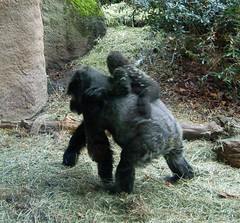
It was fascinating to see the baby and her older sister playing together. The sister would pound her chest as the play signal to start chasing her, and the baby would start chasing the sister in circles around their mom. The baby tried it a couple of times, but couldn't quite get it down, so she looked like she was trying the rub-belly/pat-head trick that kids try. The two would also play wrestle a little, and then start chasing again. Usually the baby chased the sister, I think the sister chased the baby once.
The sister also carried the baby under her belly and on her back, letting the baby jump off.
The mom was pretty patient with the whole thing, only reaching in a couple of
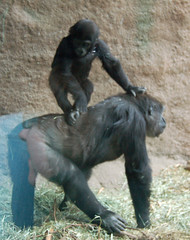 times and pulling the baby out of the play fighting to calm her down, or to breastfeed her. The way that kid went for the nipple man, WOW, poor mom.
Since I am studying play right now for my thesis, watching these two spend time playing was just fascinating and made my week!
I felt so honored to see this family hanging out, getting along, and playing.
See more photos on my flickr.
Wednesday, February 18, 2009
Zoo photos
This has truly become the zoo blog rather than much complex interplay. It's pretty much just me and the other invisible contributor - aka my husband Rafe - sharing our adventures at the Woodland Park Zoo in Seattle, WA. But there is a lot to explore there, and we are happy to support research and preservation of habitats for all animals.
For example, Rafe's birthday adventure? What else - taking our family and friends to the zoo to see their primate brethren.

Baby gorilla wants to play with or eat the stick, I can't tell.

Golden lion tamarin (aka marmoset) doin' her thing.

My nephew Gage is not impressed with the orangutan (and the orangutan doesn't look all that impressed either).
I am always fascinated to see these guys in action. They all have their own movement and behavioral patterns, yet these patterns are also so recognizable as being shared by us humans.
See all the photos from that day on my Flickr.
For example, Rafe's birthday adventure? What else - taking our family and friends to the zoo to see their primate brethren.
Baby gorilla wants to play with or eat the stick, I can't tell.
Golden lion tamarin (aka marmoset) doin' her thing.
My nephew Gage is not impressed with the orangutan (and the orangutan doesn't look all that impressed either).
I am always fascinated to see these guys in action. They all have their own movement and behavioral patterns, yet these patterns are also so recognizable as being shared by us humans.
See all the photos from that day on my Flickr.
Monday, February 9, 2009
Siamang Part II
We went to the Woodland Park zoo this weekend on a sunny, relatively warmer day, and once again visited the Siamang enclosure (see blog on 1/8/09). When we got there, the female was busy nibbling on a carrot and not very interested in people. Rafe waited for the loud screamy kids to pass by, then crouched down again at the glass.
At first the female didn't seem to notice him. So Rafe hopped a little to get her attention. She stopped mid-bite to look at him. Rafe hopped again. She shook. He shook back. She dropped her carrot and carefully bipeded her way across the branches to the glass towards Rafe. They looked at each other. Then she turned her back. He groomed. It was deja vu all over again.
Unfortunately this time when Rafe turned around and presented his back to her she didn't groom him, but the fact that we could repeat the same event as before is pretty cool. We were able to ask some volunteers if they'd ever seen any behavior like that before, and they said they had seen a little girl play a mirror-type game with the male (she'd jump, he'd jump; she'd wave her arms, he'd wave his arms), but never anything like that with the female.
Still pretty amazing proof in both the male and the female siamang that they can pretend/play/imagine.
Thursday, January 8, 2009
We got to play with Siamangs
Rafe and I visited the Woodland Park Zoo on January 2nd. We LOVE going to the zoo but rarely get to, so this was a big treat for us. What made it more exciting was that the animals hadn’t had many visitors in the past couple of weeks due to bad weather and holidays, so they were excited to see us too. Even on this freezing cold day any of the animals that had thick fur were out and about, lounging around on rocks or scrounging their habitats for food. We got to see animals that normally wouldn’t give zoo visitors so much as a glance: snow leopards, a wolf, wild dogs, even the gorillas seemed in a good mood. They viewed us from their side of the fence, totally comfortable with us staring back like the obsessed fans and paparazzi we truly are.
But the most exciting interaction that day was between Rafe and a siamang (a type of gibbon). They are tropical animals, and so were keeping warm inside their enclosure. They are typically friendly and interested in the humans that come by, and today was no exception.
As we walked up to peer inside their enclosure, the female siamang came over to look at us. Rafe, a large and fairly intimidating figure, got down to a crouching position in hopes the siamang would come over to see us. Instead, she hopped and shook at us. We weren’t sure if this was a threat behavior or not. The siamang shook and jumped again. This time Rafe tried it too. This frankly shocked the siamang, and so she did it a third time. When Rafe jumped a second time, she came straight over to the glass, as if to give Rafe a piece of her mind. She stared at him intently. Then, she turned her back towards him, almost as if a child does when pouting. She glanced over her shoulder at him. She reached out her right hand, one of her long fingers extended. Rafe pretended to grab it through the glass. She sort of wiggled her finger in response, and kept staring at Rafe. So Rafe tried something else. He started play-grooming her through the glass.
It looked very silly, this big man squatting down picking at the glass next to a siamang’s back. I expected the siamang to jump back from this weirdo (gently) tapping and scraping on her window. But instead, she seemed to relax into it. She put her arm down and turned away from Rafe so that she was no longer looking at him, but seemed interested in him continuing. He kept miming picking at her fur, even pretend ate a couple of mites he found.
This behavior went on for awhile. The siamang would look back occasionally to make sure Rafe was still going, especially if he paused for a minute, and so Rafe continued. The sight of a grown man grooming a siamang got the attention of a couple of other zoo goers, and they came over to watch. The siamang just stayed right there, being play-groomed.
Eventually Rafe stopped, and the siamang sort of looked up at him expectantly. Then she quickly jumped down from her side of the glass and swung off to explore other things.
Rafe and I giggled at this event and continued through the exhibit to see the other siamang. But the female wasn't done yet, and found us at another window. Once again Rafe crouched on all fours to say hello again. She came over to the glass, and reached out a hand for Rafe. She then turned her back to the glass, again as if she weren’t interested in him. Rafe began grooming her. She looked over her shoulder at Rafe, and seemed content to continue this activity. Just to see what would happen, Rafe stopped and moved over to another part of the glass. The siamang followed, and repositioned herself against the glass. Rafe continued grooming.
This was an incredibly odd sight to see a human primate being allowed, nay, encouraged, to groom a siamang, even if it was through the safety of thick glass. It seems unlikely that she could have felt him as he gently tapped his two fingers against the glass as he grabbed at imaginary mites.
Again a crowd formed, and eventually one of them said he should turn around and present his back to the siamang to be groomed. He did. For a second, they just sat there, back to back. Then, she turned around and actually started to groom Rafe. A pick here, a pick there, through the glass she grabbed at invisible mites. After about 20 seconds though, she turned around and pressed herself back up against the glass, and it was once again Rafe’s turn. We all laughed, someone said she was being selfish, and Rafe went right back to grooming her.
Eventually the crowd dispersed, and it was time to move away from the siamang enclosure. Rafe stopped grooming her and sat back on his haunches. She was not looking at him but realized he had stopped grooming her, and turned to look at him. Rafe put his hand up against the glass to say good bye, and if I remember correctly she tapped at it, but almost as if to request more grooming. Rafe instead stood up and walked to the other side of the glass. The siamang followed him there, and when she realized their grooming session was over, hopped over to a branch in her enclosure and then ran off to find other exciting things.
As we walked away we couldn’t help but laugh in awe and amazement at this interaction. First, who thinks to play-groom with a wild animal, especially through practically bullet-proof glass? Apparently Rafe does. And the fact that the siamang took to it was just amazing, and almost unreal to see. Let alone that the siamang actually groomed Rafe back, albeit for only a short, half-hearted time. The inter-species interaction was completely surreal.
Did anyone else happen to be at the zoo that day and see this? What was your reaction? Have you ever seen this type of behavior before, not even from siamangs specifically, just other primates in general? After this event I almost wonder if this is something the siamang has tricked other visitors into doing, but again, who thinks to play-groom?
Friday, August 8, 2008
In honor of the Olympics
1900 year old chariot found in Bulgaria.
That's pretty much it. There's a lot of primate action going on, including the discovery of something like 125,000 lowland gorillas previously uncounted (Yippee!), but not much else has gotten me inspired to post.
That's pretty much it. There's a lot of primate action going on, including the discovery of something like 125,000 lowland gorillas previously uncounted (Yippee!), but not much else has gotten me inspired to post.
Subscribe to:
Posts (Atom)

 Posts

